What is Algebra and is it useful?
Algebra is a branch of mathematics that uses symbols or what we call variables to represent vales instead of only using spercific types of values. Algebra allows you to work with special types of patterns and relationships you will not find in simple arithmetic.
An example of a relationship is the equation
y = mx + b or
y = 2x - 1 (when we assign a value)
The equation tells you when x increases by 1, y increases by 2 and when x = 0, y = -1.This is an example of us using algebra to describe the relationship of linear lines.
Basics and intro to Algebra
Simple arithmetic includes several basic operations, such as addition, subtraction, multiplication, division, and exponentiation. Each operation has its own name and purpose. for example, if we wanted to add the number 3 + 4 it would look something like this.
(it's going to be harder than this)
Theres a lot of combinations for making a number add up to 7, it could be 6 + 1 or 4 + 3 etc. If we want to write a mathematical statement that shows a number adds up to 7, we have to move from arithmetic to what we call Algebra. Algebra allows us to write all kinds of mathematical statements like for example these 2 numbers add up to 7 e.g. (a + b = 7)
The equation says "The numbers are represented by a and b to add up 7"
(a) and (b) is what we call a variable. (you will see it a lot in programming)
since the numbers (a) and (b) are variables, they could represent any type of number (value)
We picked the letters (a) and (b) to represent our values, this is what we call a variable. a variable is simply a letter that acts like a container to store a value. if we assign (a) = 3 and (b) = 5 then our equation would go like this.
But 3 + 5 does not equal 7, it equals 8? Yes! you're correct and what I just showed you is what we call a false math statement, because 3 + 5 does not equal 7 but 8. If a math statement does not match the value, then it is wrong.
examples of false math statements
One of the largest differences between arithmetic and algebra is the step " let a represent a number ". the rest is mainly what I think of as " harder arithmetic ".
Numbers and Positive and Negative numbers??
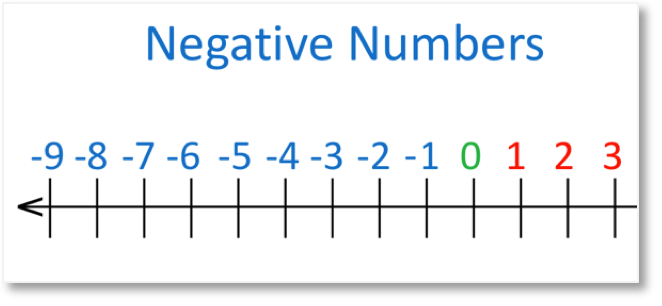
You are probably use to the numbers 1,2,3,4,5 and so on. And likely know that we start counting from the number 0, But what about numbers that are less then 0? Well, that's what we call negative numbers. When we go less than the number 0, we start encountering numbers like -1, -2, -3 and so on (up to infinity).
The number 0 is not positive but also not negative. It is a nonnegative and a nonpositive
And no Negative numbers are not whole numbers.
Whole numbers are 1,2,3,4,5 and so on. They include all counting numbers and 0 but they do not include negative numbers, fractions and decimals.
if we divide an integer by a nonzero integer we make a rational number. Every integer is a rational number including 0, an example of a rational number is 1/3, (it's a fraction but still rational). Numbers that cannot be written as a rational number are numbers that cannot be written as a one integer divided by another. an example of an irrational number is pi or the √2
The Q symbol you saw — ℚ — stands for the set of all rational numbers.
and ∉ means “is not in the set of.”
π is not in the set of rational numbers.
Commutative and Associative properties
Example of commutative.
a + b = c is the same as b + a = c
Example of associative.
(a + b) + (1 + 2)
(b + a) + (1 + 2
In these examples we show that if we change the order and group, we will get the same answer. This is useful for calculating large sums like 3589 + 1238 + 5863.
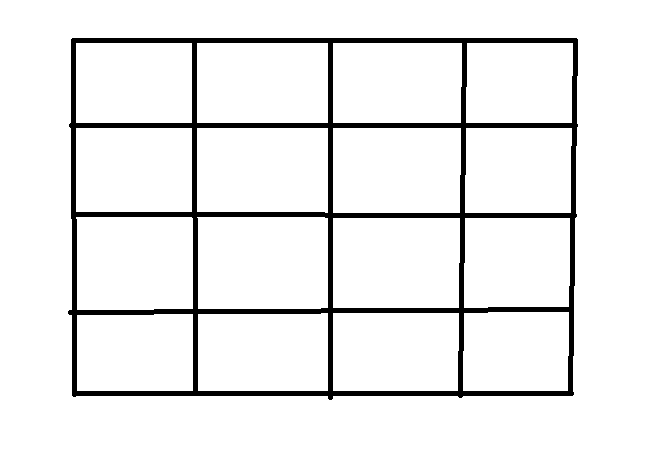
Mark and Luke are trying to count the tiles in the table. Mark says there is 4 columns with 4 tiles each so there should be 4 x 4. Luke says there is 4 columns with 4 tiles each so it should be 4 x 4.? The correct answer which is pretty obvious is both of them. But the same also applies to 3 x 4 or 4 x 3. These also give the same answer because multiplication is commutative.
Some examples are